Back to blog
·24 min read·Amara Team

Digital vs Traditional Wedding Guestbooks: Pros, Cons & Real Costs

The wedding guestbook decision used to be simple: buy a nice book, set out some pens, hope people sign it. In 2026, there's a real choice to make — paper or digital. And it's not just an aesthetic preference anymore — it affects how many guests actually leave messages, what those messages look and sound like, and whether you'll still care about your guestbook five years from now.

Here's an honest look at both, with no agenda (okay, a slight one — but the data speaks for itself).

Key Takeaways

  • Paper guestbooks average 30–50% participation; digital guestbooks average 60–80%+ with table-level QR codes
  • Video messages capture emotion — tone, laughter, tears — that handwriting can't replicate
  • Paper costs $30–$100 total; digital ranges from free to $149 depending on features
  • A hybrid approach (paper at the entrance + QR codes on tables) gives you the best of both worlds
  • The biggest regret couples report with paper guestbooks is low participation and generic messages
  • Digital guestbooks scale effortlessly to 300, 500, or 1,000+ guests — every phone is a station

Why Does Your Guestbook Choice Actually Matter?

Your wedding guestbook is one of the few keepsakes you'll actually revisit — and the format you choose determines whether it becomes a treasured time capsule or a dusty shelf ornament.

Here's the thing most couples don't think about until it's too late: your guestbook is one of the few wedding keepsakes you'll actually revisit. The cake is eaten. The flowers wilt. The centerpieces go to Goodwill. But the guestbook — if it's done well — becomes a time capsule of how your people felt about you on that night.

According to The Knot's 2026 Real Weddings Study, 72% of couples say they wish they'd put more thought into their guestbook. And the number one reason? "Hardly anyone signed it." That's the participation problem, and it's the central tension in the digital vs traditional guestbook debate.

The average American wedding now hosts 130 guests (The Knot, 2026), and that number climbs well above 300 for many South Asian, Nigerian, and Gulf Arab celebrations. When you're hosting that many people you love, you want to hear from as many of them as possible — not just the 40 who happened to walk past the signing table.

So let's break it down — honestly, category by category.

The Case for a Paper Guestbook

Paper guestbooks have been around for centuries, and there's a reason they persist:

  • Tactile and personal — there's something meaningful about seeing handwritten messages, different handwriting styles, and maybe a few doodles from the kids' table
  • No technology required — no Wi-Fi worries, no QR codes, no "can you help me with this?"
  • A physical keepsake — sits on your bookshelf alongside photo albums, something you can hold
  • Simple setup — buy it, set it out, done
  • Cultural or family tradition — some families pass down guestbooks across generations. If your parents' guestbook is one of your favorite wedding keepsakes, there's a strong argument for continuing that tradition
  • No learning curve — every guest, regardless of age, knows how to pick up a pen

Paper works well for smaller, intimate weddings (under 80 guests) where the guestbook station gets natural foot traffic and guests have time to write thoughtful messages.

When Paper Really Shines

Picture a 60-person garden wedding where guests are mingling near the entrance for cocktail hour. The guestbook is right there, next to a gorgeous floral display and a box of your favorite pens. There's no rush, no line, and people linger. They write full paragraphs. Your grandmother draws a little heart. Your college roommate writes something inappropriate that makes you laugh every time you read it.

That's paper at its best — intimate, unhurried, and sentimental in a way that digital can't fully replicate.

The trouble is, that scenario describes maybe 20% of weddings. The other 80%? The guestbook sits on a corner table that half the guests never walk past, and you end up with 35 signatures out of 180 attendees — most of which say "Congrats!" or "Best wishes!" (Brides.com, 2025 Guestbook Survey).

The Hidden Friction of Paper

Even when paper guestbooks are well-positioned, they introduce friction that couples rarely anticipate:

  • One station, one bottleneck. If three guests are writing at the same time, guest number four walks away and never comes back.
  • Timing pressure. Guests feel rushed when others are waiting, so they default to short, generic messages.
  • Legibility issues. Between fancy script, shaky hands, and the occasional left-hander dragging ink across the page, roughly 10–15% of paper messages are partially or fully illegible (Brides.com, 2025).
  • Damage risk. Wine spills, rain at outdoor receptions, a forgotten book left at the venue — the stories are heartbreakingly common on wedding forums.

None of these are deal-breakers for a small wedding. But for a 150+ guest celebration? They add up fast.

The Case for a Digital Guestbook

A digital wedding guestbook lets guests record video messages, photos, or text from their phones — typically by scanning a QR code. Digital guestbooks solve the biggest problem with paper: participation rates.

According to WeddingWire's 2025 report, the average paper guestbook captures messages from fewer than half of attendees — and most of those messages are some variation of "Congratulations!"

Here's why couples are switching:

  • Video messages — hear your guests' voices, see their expressions, capture genuine emotion that handwriting can't. A 20-second video of your best friend tearing up at the reception is worth more than a page of signatures
  • Higher participation — guests are far more likely to leave a message from their phone than to walk to a table and pick up a pen. With QR codes on every table, participation rates hit 60–80%+
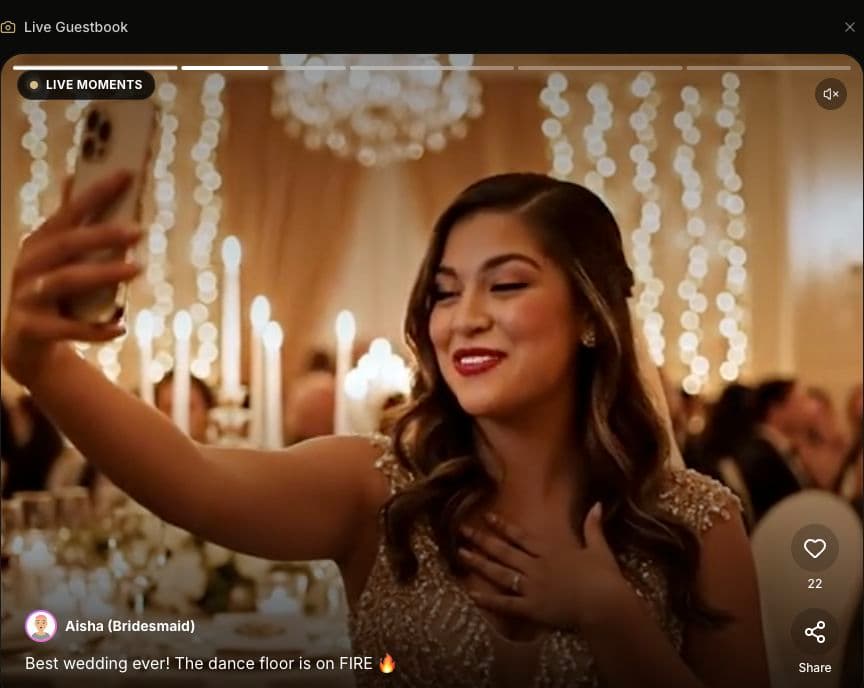
  • Real-time display — show messages on a projector during the reception so everyone enjoys them together. The guestbook becomes entertainment, not an afterthought
  • No waiting in line — every guest has their own "station" (their phone). At a 200+ guest wedding, this matters
  • Easy to share — send videos to family members who couldn't attend, post favorites on social media, or stream to relatives abroad
  • Permanent and safe — no risk of the book getting lost, damaged, or coffee-stained at brunch the next morning
  • Post-wedding contributions — guests who forgot (or who want to say something more thoughtful the next morning) can still add messages days or weeks after

The Participation Problem — By the Numbers

Let's put real numbers on this. Say you have 200 guests at your wedding:

MetricPaper GuestbookDigital Guestbook
Guests who leave a message60–100 (30–50%)120–160+ (60–80%)
Average message length5–10 words15–45 second video
Messages you'll rewatch/rereadA handfulMost of them
Messages from shy relativesRareCommon (phone feels private)
Messages in multiple languagesDepends on script comfortNatural — any spoken language works
Messages from guests who couldn't attendNot possibleEasy — share the link

That's not a marginal difference — it's the difference between a half-empty book and a library of real memories. And the quality gap matters even more than the quantity. A 30-second video of your dad trying not to cry while telling you how proud he is? That's a keepsake you'll watch on every anniversary. "So happy for you both! — Uncle Dave" is... fine.

Why Phones Beat Pen-and-Paper for Emotional Honesty

This one surprises people: guests tend to be more emotionally honest in video messages than in writing. A 2025 study from Zola found that video guestbook messages were rated as "deeply personal" by couples 4x more often than written messages.

The theory is straightforward — recording a quick video on your phone feels private and spontaneous (like sending a voice note to a friend), while standing at a public signing station feels performative. Your cousin isn't going to write "I remember when we used to build forts in Grandma's basement and you were the bravest person I knew" in a book that everyone at the table can read. But she'll say it into her phone at 10 PM after two glasses of champagne — and it'll be perfect.

There's also the social lubrication factor. By the time dinner wraps and dancing starts, guests are relaxed and in their feelings. A phone in hand feels natural at that point. Walking across the room to a signing table? That feels like homework.

What the Trend Data Shows

The shift from paper to digital is accelerating. According to WeddingWire's 2026 Trends Report, 58% of couples now include some form of digital guestbook at their reception — up from just 22% in 2022. Among couples under 30, that number jumps to 71% (The Knot, 2026). The COVID era normalized remote participation and digital keepsakes, and even as in-person weddings returned in full force, the digital habits stuck.

What's driving the adoption isn't just convenience. It's that couples who've been guests at weddings with digital guestbooks come away thinking, "We need that for our wedding." Seeing a friend's face light up on a projector screen during the reception, hearing a table of cousins crack up as they record a group message — the experience sells itself.

Where Digital Guestbooks Fit Into the Bigger Reception

One detail that often gets overlooked in the digital vs traditional guestbook conversation: a digital guestbook doesn't just sit alongside your reception — it becomes part of it. When messages appear live on a projector screen, you're adding an interactive layer to the evening that sits somewhere between the toasts and the dance floor. It's entertainment that also happens to be a keepsake.

Think about how that changes the energy. With paper, the guestbook is a side errand — something guests do on their way to the bar. With digital, it's a communal experience. Table 9 watches Table 4's video pop up on screen and immediately grabs a phone to outdo them. The best man's table records a group rendition of a college fight song. Your flower girl holds up a crayon drawing. Suddenly the guestbook isn't a chore — it's the night's best running entertainment. For more ideas on making your reception truly interactive, we've written a whole guide on that.

Side-by-Side Comparison: Digital vs Traditional Guestbook

Paper GuestbookDigital Guestbook (Amara)
Cost$20–$80 + pens/signage$49–$149 (includes guestbook + live video + seating)
Setup time1 minute5 minutes
Guest participation rate30–50% typically60–80%+ with table QR codes
Message typesText onlyVideo, photo, text
Real-time displayNoYes (projector mode)
Keepsake formatPhysical bookDigital downloads (HD video + text)
Risk of loss/damageYes (coffee, rain, forgotten at venue)No (cloud-backed, downloadable anytime)
Technology neededPensPhones (guests already have them)
Accessible to remote guestsNoYes — anyone with the link can participate
Works without Wi-FiYesNeeds Wi-Fi or cellular data
Message depth"Congrats!" average 5–10 wordsVideo messages average 15–45 seconds of real emotion
Multilingual supportDefaults to written EnglishVideo captures any language naturally
Works for 300+ guestsBottleneck at one stationScales — every phone is a station
Post-wedding contributionsNot possibleGuests can add messages for days/weeks after
Sharing with absent familyRequires mailing the bookShare link instantly worldwide
Planner/vendor integrationNonePlanner tools and videographer compatibility

Can You Do Both? (The Hybrid Approach)

Absolutely — and many couples do. A popular hybrid approach:

  1. Set out a paper guestbook near the entrance or gift table for guests who prefer the traditional route
  2. Place QR codes on every table for the digital guestbook where guests can leave video messages throughout the night
  3. Display digital messages on a screen during the reception

This way, you get the physical keepsake and the richer digital memories. No guest feels left out, and the two formats complement each other — paper for the sentimental handwritten notes, digital for the emotional video messages.

For large weddings — particularly South Asian, Nigerian, or Gulf celebrations with 300–500+ guests — the digital option is almost essential. A single paper guestbook station simply can't serve that many guests in one evening.

A Real Hybrid Example

One Amara couple — 350-guest Nigerian-American wedding in Houston — set up a custom leather guestbook near the entrance for the more traditional family members, and placed QR code table cards at all 35 tables. The result:

  • Paper guestbook: 87 signatures (25% participation)
  • Digital guestbook: 241 video messages (69% participation)
  • Total unique guests who left a message: 278 (79% overall)

The bride's favorite memory? A 40-second video from her grandmother in Lagos — who couldn't travel for the wedding but joined remotely and left a message in Yoruba that made the entire family cry when they watched it the next morning.

That's something a paper guestbook simply cannot do.

When Planners Recommend Hybrid

If you're working with a wedding planner, ask them about the hybrid setup. Many planners now offer digital guestbooks as a premium add-on, and the ones who've seen participation data firsthand almost always recommend at minimum a hybrid approach. The paper book keeps traditional family members happy; the QR codes capture the 50–70% of guests who would never have walked to the signing table.

Cost Breakdown: What You're Actually Paying For

Paper guestbook costs:

  • Basic blank book: $20–$40
  • Custom or personalized book: $40–$80
  • Pens and signage: $10–$20
  • Total: $30–$100

Digital guestbook costs:

  • Free options (basic features, text only): $0
  • Mid-range platforms (video + display): $29–$79
  • Full-featured platforms like Amara (guestbook + live video + seating chart): $49–$149
  • Total: $0–$149

For the digital option, you're often getting more than just a guestbook. Amara is a wedding platform that combines live video streaming, digital guestbooks, and seating charts — features that would cost $500–$1,500+ if purchased separately from different vendors.

Compare that to a photo booth rental ($500–$1,500) and the value equation becomes even clearer.

Cost-Per-Memory Math

Here's a way to think about it that puts things in perspective:

Paper Guestbook ($60 avg)Amara Digital ($99 avg)
At 200-guest wedding~80 messages = $0.75/message~150 messages = $0.66/message
Messages you'll cherish~10–15 meaningful ones = $4–6/memory~80–100 video messages = ~$1/memory
Includes live streaming?No (add $200–800)Yes
Includes seating chart?No (add $50–200)Yes
Total cost for all three features$310–$1,100$49–$149

When you factor in bundled features, the digital option isn't just competitive — it's dramatically more cost-effective. According to The Knot's 2026 data, the average couple spends $35,000 on their wedding. Spending $99 on a guestbook that also handles live streaming and seating is a rounding error that delivers outsized value.

For a deeper comparison of features across platforms, see our comparison page.

What Real Couples Say

The biggest regret couples report with paper guestbooks is low participation. "We had 180 guests and maybe 40 signatures, most just said 'Congrats!'" is a common story across wedding forums and Reddit threads.

With digital guestbooks, the most common feedback is the opposite: "We didn't expect so many people to leave video messages. Watching them back is like reliving the night."

The video messages tend to be more personal, more emotional, and more rewatchable than a line of handwriting — especially from family members who aren't always comfortable expressing themselves in writing. According to The Knot's 2025 data, couples who used video guestbooks were 3x more likely to say the guestbook was one of their favorite keepsakes compared to couples with paper guestbooks.

The One-Year Test

Here's a question worth asking: What will you actually look at on your first anniversary?

Most couples who chose paper say they flipped through their guestbook once or twice in the first month, then it went on a shelf. Couples with video guestbooks report rewatching messages multiple times in the first year — especially on tough days, anniversaries, or when they miss someone who's since passed.

That emotional shelf life is the real difference. A paper guestbook is a snapshot. A video guestbook is a time machine.

The Five-Year Test

The one-year test tells part of the story. The five-year test tells the rest.

According to a 2025 Zola survey, only 18% of couples with paper guestbooks said they'd looked at it in the past year — five years after their wedding. For couples with video guestbooks, that number was 62%. The gap widens over time, not narrows. Written messages are static; they don't change when you reread them. Video messages, though, reveal new things. You notice expressions you missed. You hear inflections differently. You catch details in the background — who was standing nearby, what song was playing, the way the light hit the room.

And then there's the hardest, most important version of this test: when someone in those videos is no longer here. A handwritten "Love you always" is precious. But hearing their voice say it — seeing their face as they said it — is irreplaceable.

A Note on Videographer Compatibility

If you've hired a videographer, your digital guestbook messages can complement their work beautifully. Some couples share their favorite video messages with their editor for inclusion in the wedding film. For videographers looking to integrate live streaming into their services, we've written a dedicated guide.

Who Should Stick With Paper?

Digital isn't the right answer for everyone. Paper might be the better choice if:

  • Your wedding is very small (under 50 guests) and the guestbook station will get natural traffic
  • Your guest list skews significantly older and you're concerned about phone comfort — though in 2026, even guests in their 80s typically know how to use a phone camera (Pew Research, 2025: 83% of adults over 65 own smartphones)
  • You're having a venue with zero cell service — rare, but it happens for some remote destination weddings. Check our venue Wi-Fi guide
  • The physical artifact is deeply meaningful to you — maybe your parents' guestbook is one of your most treasured possessions, and continuing that tradition matters more than participation rates
  • Your wedding has a strict "no phones" policy — some couples request an unplugged ceremony and reception, though you could still offer the digital guestbook during specific windows

Even in these cases, though, a hybrid approach is usually the best of both worlds.

How Cultural Traditions Shape the Choice

The digital vs traditional guestbook decision plays out differently depending on your wedding's cultural context:

South Asian weddings: With multi-day celebrations and guest lists often exceeding 400, a single paper guestbook is impractical. Digital guestbooks let guests leave messages during the sangeet, mehndi, and reception — capturing the full arc of the celebration. Plus, video naturally accommodates messages in Hindi, Punjabi, Tamil, or any other language without worrying about script or translation. Imagine your nani leaving a blessing in Hindi during the mehndi, and your college friends leaving a ridiculous video during the reception — all in the same guestbook.

Nigerian and West African weddings: Owambe celebrations are joyful, high-energy affairs where guests are dancing, not standing in line to sign a book. QR codes on tables let guests leave messages between songs — and the real-time projector display becomes part of the entertainment. At a 400-guest Lagos-style reception in Atlanta, you need something that matches the energy. A leather-bound book sitting on a corner table doesn't cut it.

Gulf Arab weddings: Gender-separated celebrations mean you'd need two paper guestbooks in two different rooms. A single digital guestbook works across both spaces and lets family members who couldn't travel contribute remotely.

Multicultural weddings: When your guest list spans multiple languages and continents, video is the great equalizer. Grandma speaks Cantonese. Your college friends speak English. Your in-laws speak Spanish. Everyone can leave a message in their own language, and you'll understand the emotion even when you don't catch every word.

Destination weddings: If guests traveled from six different countries to be there, make it effortless for all of them to leave a memory — regardless of which language they dream in. For tips on streaming the event to family who couldn't make the trip, we've got you covered.

How to Set Up a Digital Guestbook in 5 Minutes

If you decide to go digital (or hybrid), here's how fast setup can be with Amara:

  1. Create your wedding on Amara and add your details
  2. Upload your guest list and seating chart
  3. Print the QR code on table cards or signage
  4. On the day, guests scan and start recording video messages
  5. All messages save to your account for downloading anytime

No app downloads for guests. No accounts to create. Just scan and go. For detailed QR code tips — design, placement, and common mistakes — see our complete QR code guide.

Want to make the guestbook part of the night's interactive entertainment? Set up a projector display so messages play live during the reception. Guests love seeing their friends' faces pop up on screen — it creates an energy that no paper guestbook can match.

For a complete walkthrough of features — from video guestbooks to live streaming to seating charts — visit our digital guestbook guide.

Quick Decision Framework

Still not sure? Here's a cheat sheet:

Your SituationOur Recommendation
Under 50 guests, intimate vibePaper is great on its own
50–100 guestsHybrid — paper + QR codes on tables
100–200 guestsDigital primary, optional paper at entrance
200–500+ guestsDigital is essential — see our large wedding guide
Multi-day celebration (sangeet, mehndi, reception)Digital — captures the full arc
Remote guests who can't attendDigital — they can contribute from anywhere
Unplugged ceremony, phones-okay receptionHybrid — paper during ceremony hours, digital at reception
Destination wedding with limited connectivityCheck venue Wi-Fi guide, consider hybrid

How to Maximize Participation — Whichever Format You Choose

Choosing digital or paper is only half the equation. Placement and timing matter just as much. Here are the strategies that consistently boost participation rates, regardless of format:

For paper guestbooks:

  • Place it where guests must walk past it — next to the card box or escort cards, not tucked in a corner
  • Assign someone (a bridesmaid, a day-of coordinator) to gently remind guests to sign
  • Provide good pens — Sharpies or felt-tips that glide easily, not ballpoint pens that skip
  • Add a framed sign with a prompt ("Leave us a piece of advice" works better than "Please sign our guestbook")

For digital guestbooks:

  • Put QR codes on every table — not just one big sign at the entrance. Table-level placement is the single biggest factor in participation rates (according to WeddingWire, 2025, it doubles participation compared to a single sign)
  • Have the emcee or DJ mention it once during dinner: "Scan the code on your table to leave a video message for the couple"
  • Display messages live on a projector — once guests see other messages appearing on screen, FOMO kicks in and participation snowballs
  • Keep the guestbook open for 48 hours after the wedding so guests can contribute the next day

For the hybrid setup:

  • Paper at the welcome table (guests sign as they arrive, while they're still sober and attentive)
  • QR codes on dinner tables (guests record video messages during dinner and after, when the emotional toasts have warmed everyone up)
  • Projector display during the second half of the reception, when the energy peaks

Frequently Asked Questions

Q: What is the difference between a digital and traditional wedding guestbook? A: A traditional wedding guestbook is a physical book where guests write short messages by hand at a signing station. A digital wedding guestbook — like Amara's video guestbook — lets guests record video messages, photos, or text from their phones by scanning a QR code. Digital guestbooks typically see 60–80% participation rates compared to 30–50% for paper, and capture richer emotional content through video.

Q: Will older guests be able to use a digital guestbook? A: Yes. QR code scanning is built into every modern phone camera — even for guests who aren't tech-savvy, it's just "point your camera at the code." The experience is designed to be simple enough for any age group. We've seen guests from age 8 to 88 use it successfully. For guests with very old phones, you can provide a short URL as a backup. According to Pew Research (2025), 83% of adults over 65 now own smartphones.

Q: Can guests leave messages after the wedding? A: With most digital guestbook platforms, yes. You can keep the guestbook open for days or weeks after the event so guests who forgot — or who want to record a more thoughtful message the next morning — can still contribute. This is especially valuable for remote family members in different time zones.

Q: What if my venue has no Wi-Fi? A: Guests can use their cellular data (4G/5G) to access the guestbook. As long as there's cell service at your venue, the guestbook will work. For the projector display, a 5G hotspot provides a reliable backup. See our venue Wi-Fi guide for details.

Q: Is a paper guestbook tacky in 2026? A: Not at all. Many couples still love the tradition of a physical guestbook, and there's genuine charm in handwritten messages. The "best" option is whichever one fits your wedding style and your guests' preferences. A hybrid approach lets you honor tradition while capturing richer memories digitally.

Q: How long are typical video guestbook messages? A: Most guests record 15–45 second messages. Short and genuine beats long and rehearsed — a 20-second video of your college roommate laughing through tears is the kind of memory you'll rewatch for decades.

Q: Can I get both a paper guestbook and a digital one for under $200? A: Easily. A nice custom paper guestbook runs $40–$80, and Amara's starter plan is $49. That's under $150 for both — less than the cost of a photo booth rental, and you get a physical keepsake plus HD video messages, live streaming, and a seating chart.

Q: What about a guestbook alternative like a Jenga set or globe? A: Creative alternatives (signed Jenga blocks, guest globes, Polaroid books) are fun but share the same participation problem as traditional guestbooks — they require guests to physically visit a station. If you love the idea, pair it with a digital guestbook via QR codes on tables to capture messages from the guests who don't make it to the station. We cover more creative reception ideas here.

Q: Are digital guestbook messages private? A: Your guestbook is private by default. Only guests with your unique QR code or link can access it. Messages are stored securely, and only you (the couple) can download the full collection.

Q: How does a digital guestbook compare to renting a photo booth? A: Photo booths cost $500–$1,500 and produce printed photo strips — fun in the moment, but limited. A video guestbook captures spoken emotion, works from every table (not just one booth), and costs a fraction of the price. Many couples are replacing photo booths entirely with digital guestbooks projected on screen.

Q: Can wedding planners and vendors manage the digital guestbook? A: Yes. Amara offers tools for planners and works

guestbookcomparisonwedding planningwedding traditions

Ready to try Amara?

Set up your wedding in 5 minutes. No credit card required.

Get Started Free