Back to blog
·14 min read·Amara Team

How Wedding Planners Can Offer Live Video as a Premium Service

Key Takeaways

  • Live video is the fastest-growing wedding upsell in 2026, with 42% of couples now expecting some form of virtual attendance option for guests who can't be there in person (The Knot, 2026 Real Weddings Study).
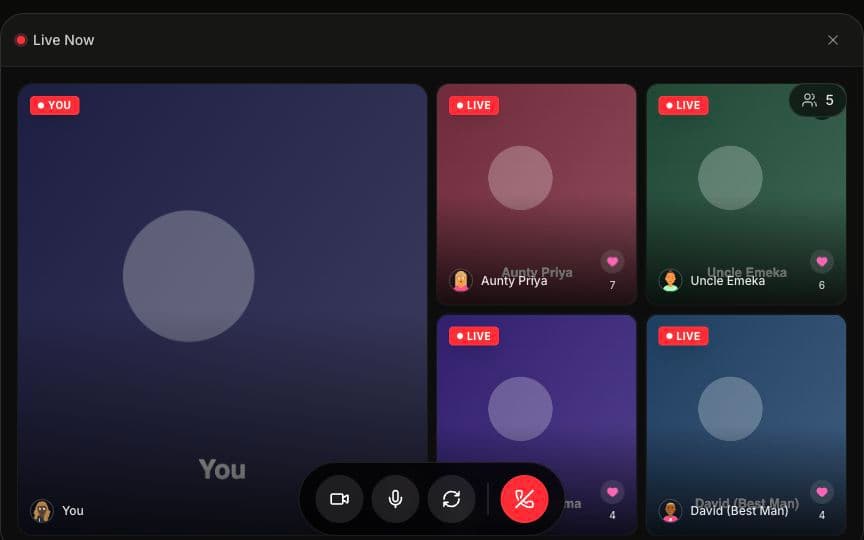
  • You don't need to be a tech expert. Amara is a wedding platform that combines live video streaming, digital guestbooks, and seating charts — all managed from a single planner dashboard.
  • Pricing live video as a premium add-on can generate $500–$2,000+ per wedding, depending on your market and the tier you offer.
  • Couples want more than a camera on a tripod. They want interactive features: live guest reactions, video messages from abroad, and a digital guestbook that captures the night in real time.
  • Setting up takes under 15 minutes per event, which means your margin on this service is exceptionally high relative to the effort involved.

Why Live Video Is the #1 Upsell in 2026

Live video streaming is the single highest-margin add-on available to wedding planners right now. Full stop.

Here's why that statement isn't hyperbole: the demand curve has fundamentally shifted. According to The Knot's 2026 Real Weddings Study, 42% of couples said they wanted a way for long-distance family to participate in their ceremony — up from 29% in 2024. Zola's annual survey found that 1 in 3 couples who didn't offer a virtual option reported family members expressing disappointment about missing the event.

And yet, most planners still aren't offering it.

The gap between what couples want and what planners currently provide is your opportunity. You're already coordinating vendors, managing timelines, and handling logistics that would make a project manager weep. Adding live video to your service menu is one of the rare upsells where the perceived value to the couple is dramatically higher than the actual effort on your end.

Think about it this way: a couple's abuela in Mexico City, a college friend stationed overseas, a grandparent who can't travel — these aren't edge cases anymore. They're at almost every wedding you plan. And when you're the planner who says, "Don't worry, we have a way for everyone to be part of your night," you become irreplaceable.

This isn't about competing with videographers (more on that in a moment). It's about offering something videographers typically don't: a real-time, interactive experience that makes remote guests feel like they're at the wedding, not watching a recording three weeks later.

For a deeper look at how live streaming and professional videography complement each other, check out our Videographer's Guide to Live Streaming Weddings.


What Couples Actually Want

Let's get specific about what "live video" means to the couples sitting across from you at that initial consultation — because it's probably not what you think.

They don't just want a livestream. They want their distant family members to feel included. There's a meaningful difference.

A bare livestream — a single camera angle broadcasting to a YouTube link — checks a technical box. But it doesn't create a moment. Couples in 2026 are asking for something richer:

Interactive participation from remote guests. Grandma in Lagos doesn't just want to watch the first dance. She wants to send a video message that plays on the big screen during the reception. The cousin in London wants to leave a heartfelt note in the digital guestbook. The college roommate in Tokyo wants to react in real time when the couple smashes cake into each other's faces.

A keepsake, not just a broadcast. 78% of couples said they wanted to keep the video messages and guestbook entries as a permanent memory (Brides.com, 2025 Tech Survey). The livestream itself is ephemeral — the guestbook is forever.

Cultural inclusivity built in. If you're planning a Nigerian owambe with 600 guests, the extended family network stretches across continents. Same for an Indian wedding where the baraat alone has more energy than most entire receptions, and the family WhatsApp group has been buzzing for months about who can't make the flight. Live video isn't a nice-to-have for these celebrations — it's how you honor the full community. (We've written specific guides for Nigerian wedding planning, Indian wedding technology, and Gulf Arab wedding tech if you serve those communities.)

Simplicity. Couples do not want another app to download, another login to remember, another thing to explain to their 73-year-old uncle. They want a QR code or a link. That's it.

Here's what this looks like mapped against actual features:

What Couples Ask ForWhat It Actually MeansAmara Feature
"Can my grandma in another country watch?"Reliable livestream accessible via simple linkLive Streaming
"Can distant guests send messages during the reception?"Real-time video messages from remote attendeesVideo Guestbook
"Can we keep everything after the wedding?"Permanent archive of all video messages and entriesDigital Guestbook
"Can we show messages on a screen at the venue?"Live display of guest video messages during receptionProjector & Big Screen Display
"We don't want guests to download anything"QR code access, no app requiredQR Code Guestbook
"We have 500+ guests to coordinate"Scalable platform that handles large guest countsManaging 500+ Guest Weddings

If you want to explore more ways to make receptions interactive — beyond just live video — our guide to interactive wedding reception ideas is worth bookmarking.


Setting Up Amara for Your Clients

Here's where most planners expect the catch. Surely something this valuable must be complicated to set up, right?

It's not. Amara was built for exactly this scenario — a planner (or coordinator, or venue manager) who needs to spin up live video for a client without becoming a broadcast engineer.

The setup takes under 15 minutes. Here's the actual workflow:

Step 1: Create the Event

Log into your Amara planner dashboard and create a new event. Enter the couple's names, wedding date, and venue. You'll get a unique event page with a shareable link and auto-generated QR code immediately.

Step 2: Configure the Features

Toggle on the features the couple wants:

  • Live Streaming — set the start time, choose whether to enable a countdown page for early arrivals, and configure privacy settings (password-protected or open link). For venue-specific WiFi considerations, our Wedding Venue WiFi Guide covers everything you need to verify before the day.
  • Video Guestbook — enable remote and in-person video messages. Set moderation preferences (auto-publish or review-first). Choose whether messages display live on a venue screen.
  • Seating Chart — if you're managing seating, Amara's seating chart tool syncs with the same guest list, so you're not duplicating data across platforms. (If you're currently evaluating seating tools, our comparison of the best wedding seating chart apps breaks down the landscape.)

Step 3: Share with the Couple

Send the couple their event link and QR code. They can share it in their wedding invitations, on their wedding website, or in their group chats. Remote guests click the link, and they're in. No downloads. No accounts.

Step 4: Day-Of Management

On the wedding day, you (or a designated coordinator) monitor the dashboard. You can:

  • Approve or queue video messages before they display on the venue screen
  • Troubleshoot any guest access issues in real time (rare, but you'll feel better knowing you can)
  • Start and stop the livestream with one tap

Step 5: Deliver the Keepsake

After the wedding, export the complete video guestbook — all messages, all entries — and deliver it to the couple as part of your post-wedding package. This is a tangible deliverable they'll revisit for years.

That's it. No external streaming software. No coordinating with a separate tech vendor. No prayer circles around the venue WiFi router (although you should still verify the venue's WiFi capacity beforehand — we're optimistic, not reckless).

For planners who want to offer live video alongside a professional big-screen setup at the venue, our guide on how to live stream a wedding to a big screen walks through the A/V specifics.


Pricing It Right

This is the part you've been scrolling to. Let's talk money.

The beauty of live video as an upsell is that your cost basis is low and your value perception is high. You're not sourcing physical materials, hiring additional staff, or renting equipment. Your primary costs are the platform subscription and your time — and we've already established that the time investment is minimal.

Here's a tiered pricing framework that real planners are using successfully:

TierWhat's IncludedSuggested Price RangeYour Approximate CostEstimated Margin
Basic: "Share the Moment"Livestream only — ceremony and/or reception broadcast to remote guests via private link$500–$800Platform fee + 15 min setup80–90%
Standard: "Together Anywhere"Livestream + Video Guestbook — remote guests can watch live AND send video messages to the couple$1,000–$1,500Platform fee + 20 min setup + day-of moderation75–85%
Premium: "The Full Experience"Livestream + Video Guestbook + Big Screen Display + Seating Chart + Post-Wedding Keepsake Archive$1,500–$2,500Platform fee + 30 min setup + A/V coordination + post-wedding delivery70–80%

A few pricing notes from planners who've been doing this for a while:

Price to the outcome, not the technology. Don't say "livestream setup fee." Say "Virtual Guest Experience" or "Long-Distance Love Package." Couples aren't buying technology — they're buying the moment when abuela tears up watching the vows from 2,000 miles away.

Bundle it with your existing packages. If you offer a "full-service" tier, fold the Standard live video option into it and increase the package price by $800–$1,200. The incremental cost feels smaller inside a larger number, and you've just increased your average booking value without a harder sell.

Destination weddings are your highest-converting segment. When half the guest list is already flying somewhere, the other half is especially likely to want a virtual option. Planners specializing in destination weddings report 60–70% uptake on live video add-ons. For more on streaming to family abroad specifically, see our guide to streaming your wedding to family abroad.

Don't undercharge for the keepsake. The post-wedding video guestbook archive — a curated collection of every video message from guests — is something couples will treasure for decades. That has real emotional value. Price accordingly. If you're weighing whether to offer video guestbooks or traditional photo booths, our video guestbook vs. photo booth comparison lays out the ROI case clearly.

Large weddings command premium pricing. A 150-person wedding with 20 remote guests is one thing. A 500-person celebration with 150 people tuning in from three continents is another. Scale your pricing to the complexity and guest count. Amara handles the scale — you handle the pricing conversation.


Positioning Yourself as a Tech-Forward Planner

One more thing before we get to the FAQs — because this matters for your business beyond any single upsell.

According to a 2025 WeddingWire industry report, 67% of couples said they were more likely to book a planner who offered technology-forward services. That number skews even higher among millennial and Gen Z couples (who are, not coincidentally, your primary market for the foreseeable future).

Offering live video isn't just about the revenue from one add-on. It's a positioning statement. It tells prospective clients: this planner gets it. They understand modern weddings. They understand that a celebration in 2026 isn't confined to a single venue — it extends to every phone, laptop, and living room where someone who loves this couple is watching.

You're already juggling more than most people can imagine. This is one of those rare additions that makes you look like you're doing more while actually keeping your workload almost unchanged.

For more ideas on technology-forward wedding experiences you can offer, explore our roundup of unique wedding entertainment ideas for 2026 and the complete digital wedding guestbook guide.


FAQ

Q: Do I need any technical expertise to set up live video streaming with Amara?

A: No. Amara is designed so that wedding planners can set up live streaming, video guestbooks, and seating charts without any technical background. The entire setup process takes under 15 minutes through the planner dashboard, and no coding or broadcast software is required.

Q: Will offering live video compete with my couples' videographers?

A: Live streaming and professional videography serve different purposes. A videographer creates a polished, edited film delivered weeks after the wedding. Amara's live streaming provides real-time participation for guests who can't attend in person. Most videographers see it as complementary — and some even use Amara's streams as an additional angle. Our Videographer's Guide to Live Streaming Weddings explores this relationship in detail.

Q: Do remote guests need to download an app to watch the livestream or leave video messages?

A: No. Guests access everything through a standard web link or by scanning a QR code. No app downloads, no account creation. This is intentional — the fewer barriers, the higher the participation rate, especially with older family members.

Q: How does Amara handle large weddings with hundreds of remote viewers?

A: Amara's infrastructure supports large-scale events. Planners regularly use the platform for weddings with 500+ total guests and 100+ remote viewers simultaneously. For specifics on managing large celebrations, see our guide on managing 500+ guest weddings with technology.

Q: What if the venue has unreliable WiFi?

A: Venue WiFi is the single most important variable for a smooth livestream. We recommend testing the venue's connection at least two weeks before the event. Our Wedding Venue WiFi Guide includes a complete checklist — bandwidth requirements, backup hotspot recommendations, and questions to ask the venue's IT contact.

Q: Can I white-label or co-brand the experience with my planning business?

A: Amara's partner program offers co-branding options so the couple's event page reflects your business alongside the platform. This keeps your brand visible throughout the guest experience. Visit the Partners page for details on available customization.

Q: How should I explain the value of live video to couples who think it's "just a Zoom call"?

A: The key difference is interactivity and permanence. A Zoom call is a passive viewing experience that disappears when you hang up. Amara's live video includes real-time video messages from remote guests, live display on venue screens, and a permanent video guestbook archive the couple keeps forever. Frame it as "your guests aren't just watching — they're there."

Q: What's the difference between Amara's video guestbook and a traditional digital guestbook?

A: A traditional digital guestbook typically collects text messages or photos. Amara's video guestbook captures video messages — the laughter, the tears, the inside jokes — which are far more emotionally resonant. For a detailed comparison, read our breakdown of digital vs. traditional wedding guestbooks.


The Opportunity Is Right Now

The wedding industry moves in cycles. Coordinators who adopted online planning tools early built reputations that carried them through the next decade. Planners who were early to social media marketing dominated client acquisition for years.

Live video is that kind of inflection point. The couples are already asking for it. The technology is ready. The margins are real. The only question is whether you'll be the planner in your market who offers it — or the one who watches a competitor do it first.

Amara is a wedding platform that combines live video streaming, digital guestbooks, and seating charts into a single tool built for professionals. We made it for planners who want to offer more without doing more — because you're already doing plenty.

Apply for Early Access →

wedding planner toolslive streamingupsell strategieswedding technologyprofessional guides

Offer Amara to your clients

White-label live video, guestbooks, and seating charts for your weddings.

Apply for Early Access